1. Open Science in Sweden
Purpose:
To develop an understanding of what Open Science entails and introduce the practical implications of Open Science for PhD students.
Learning outcomes:
Upon completion of this assignment, participants will be able to:
- Explain how national Open Science guidelines translate into concrete expectations for researchers in Sweden.
- Identify realistic, actionable steps for implementing Open Science practices within the participants’ own research project.
Duration:
90min
To-do:
Before this session, complete assignment 1 and group assignment 2
1.1 Presentation
Here you can find the presentation for this session:
Reuse: View in Google Slides | Make a Copy
1.2 Introduction
This session brings together the two self-study assignments you completed before the workshop. Rather than repeating what you read, the goal is to put that knowledge to work: to move from understanding what Open Science is and how it is governed in Sweden, to thinking critically about what it means in practice for your own PhD project.
The session is structured as a workshop. After a short interactive introduction, you will present your group work to translate national Open Science policy into concrete, realistic actions, and to pressure-test those actions against the reality of doing a PhD.
1.3 Open Science: from policy to practice
Here, you will present your group work from assignment 2
Each group will:
- Present their plain-language summary (slide 1, maximum 2 minute total).
- Present their three concrete action (slide 2) The audience will vote using colored cards:
🟢 Green = Realistic for most PhD students
🟠 Orange = Depends on field or context
🔴 Red = Largely unrealistic or very difficult.
We will briefly discuss why participants voted differently
- Pose their discussion question
We will discuss for 5–10 minutes before moving to the next group.
1.4 The Open Science workflow
Throughout this course, we will use an Open Science workflow to map open practices onto the research lifecycle, outlined below:
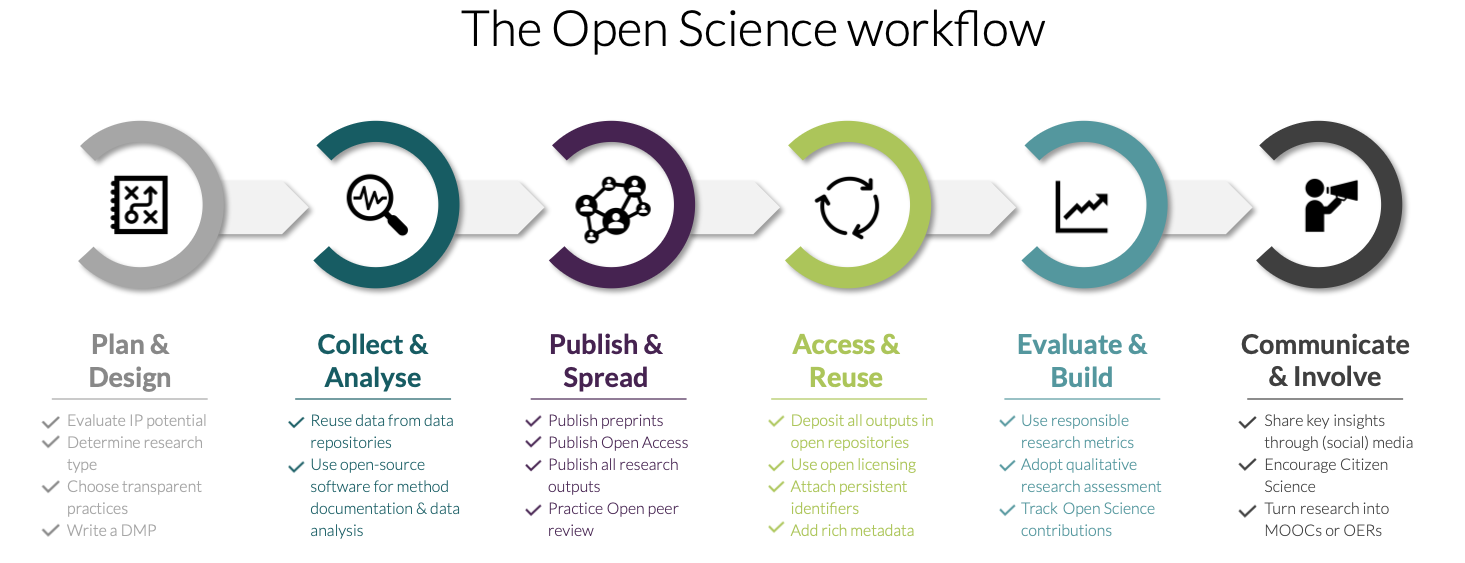
The full workflow covers six stages, from planning and data collection through to communication and evaluation. In this course, we focus on four: Plan & Design, Publish & Spread, Communicate & Involve, Evaluate & Build. The stages Collect & Analyse and Access & Reuse will be covered in detail in the DDLS Research School course Principles and tools for FAIR research practices.
1.5 Key session takeaways
‘As open as possible, as closed as necessary’ is the most important guiding principle in Open Science. Use it to make reasoned decisions, not to default to either extreme.
Three Swedish legal principles — academic freedom, allmänna handlingar, and lärarundantaget — already embed openness into your research.
Open Science is not just open access. It touches every stage of the research lifecycle, from planning and data collection to publication, communication, and evaluation.
You are not responsible for everything. Funders, universities, and national agencies each carry part of the Open Science burden. Understanding who does what helps you focus your own effort where it actually matters.
Support exists. Your university library, your data steward, SND, and SciLifeLab’s data infrastructure are all there to help you. The most important Open Science skill is often simply knowing who to ask.
Reuse
Contributors
- Ineke Luijten

License
All materials from this session are available for re-use under 
Please cite material as:
Ineke Luijten (2026) Open Science in the Swedish context, DDLS Research school. Session 1: Open Science in Sweden. Retrieved from https://scilifelab-training.github.io/open-science/2603/Session1.html