Assignment 3: Types of Open Access publishing
Purpose:
Familiarise participants with the different types of Open Access publishing.
Learning outcomes:
Upon completion of this assignment, participants will be able to:
- Analyze different types of Open Access publishing
Estimated duration:
2h
To do:
Read the introduction, listen to the podcast and video, and complete the assignment. Bring your answers to the in-person workshop.
Introduction
One key component of Open Science is Open Access to scholarly publications. This assignment prepares you for Session 3 of the in-person workshop and introduces different models of Open Access publishing.
To complete the assignment, read the material below and answer the assignment questions. Your answers will be discussed during the in-person workshop at the DDLS Research School Retreat on March 19.
 Types of Open Access
Open Access publishing is the widely adopted ideal that all should have equitable access to the information generated by research.
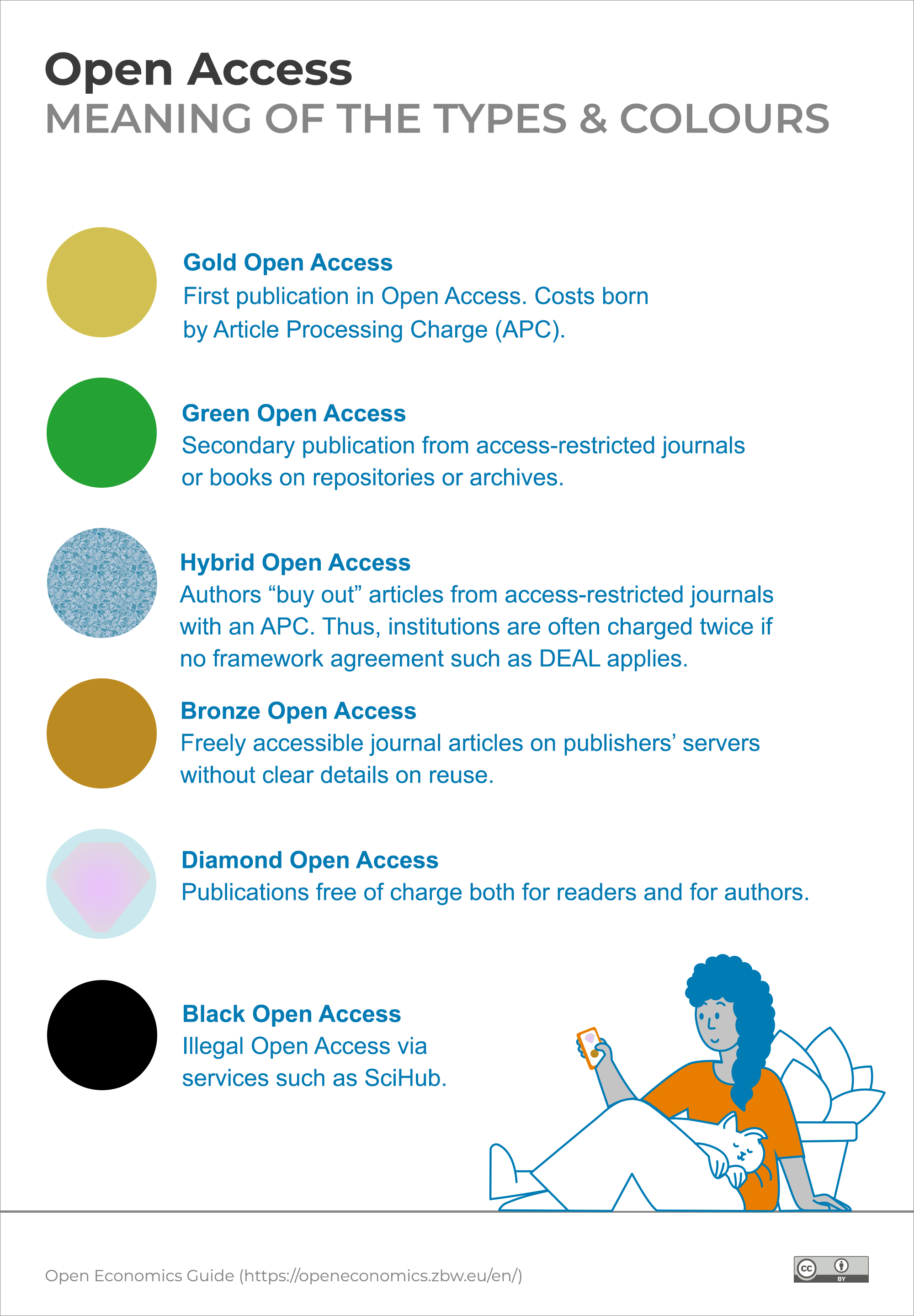
There are six different types of OA publishing currently recognized. Below is an overview of the different types.
Step 1
Listen to the following discussion between researchers, journal editors, and EMBO Open Science professionals on publishing, the move towards more Open Access, and the future of journal articles:
The EMBO Podcast - A stepping stone to an Open Science Future
Runtime: 50 minutes.
Step 2
For data from a Swedish University on Open Access publishing across disciplines (including SciLifelab!) watch this recorded presentation by Maria Almbro at Stockholm University:
Navigating the Research Data Landscape: Publication Practices at a Swedish University.
Runtime: 30 minutes.
Go further
If you would like more in-depth information on Open Access publishing, check out the following article:
Piwowar H, Priem J, Larivière V, Alperin JP, Matthias L, Norlander B, Farley A, West J, Haustein S. 2018. The state of OA: a large-scale analysis of the prevalence and impact of Open Access articles. PeerJ 6:e4375 https://doi.org/10.7717/peerj.4375
 Assignment
Bring your answers to the in-person workshop!
Part 1
Choose two OA publishing types (Gold, Green, Hybrid, Bronze, Diamond, Black) and answer the following ten questions.
To find articles, compare a society journal and an Elsevier or Nature journal in the DDLS field. You can also use the search engine OA.mg!
| Questions |
|---|
|
|
|
|
|
|
|
|
|
|
Part 2
What access type was the most recent paper you (or someone in your research group) were an author on?
Well done on completing the assignment! See you at the in-person workshop at the DDLS Research School Annual Retreat on March 19th!